
Houma Previous Residents by Era
No single roll spans a Houma address from its first use to today. Start with the source closest to the period under study, then use the parcel's legal description to bridge gaps caused by a new street name or number. The Assessor and Clerk are strongest for ownership. The Terrebonne Parish Library is stronger for occupants, kin, local news, and the setting around an old structure.
| Record source | Known time span | Place to consult | Evidence it adds |
|---|---|---|---|
| Conveyances | Online certified range from 1971; office records from 1822 | Terrebonne Parish Clerk of Court | Grantor, grantee, filing date, book/page, and legal description |
| Houma directories | Library states 1897 to present; individual years vary | Terrebonne Parish Library genealogy room | Named residents, firms, trades, and address clues |
| Terrebonne census extracts | 1840 to 1910, except 1890 | Terrebonne Parish Library | Household members on a census date |
| Sanborn maps | Library collection covers 1867 to 1970 | Library resources and Library of Congress | Street layout, building use, footprint, and number context |
| Obituary index | 1885 to 2007 | Library and Terrebonne Genealogical Society | Death notice lead, relatives, and later place clues |
| Permits and nuisance files | Record-specific | TPCG office or public-record request | Project address and named roles when releasable |
Recent work normally begins with the current parcel. For an early twentieth-century household, begin with a directory or census year and verify the lot in deeds or maps. A source date matters. Each record captures one event or publishing cycle, not uninterrupted occupancy.
Start Houma Address Records Here
The Terrebonne Parish Assessor search accepts a property address, parcel number, owner name, subdivision, legal description, or section, township, and range. The detail may show the assessed owner, physical address, mailing address, legal description, homestead field, values, and deed references. Copy the parcel number and every lot, block, subdivision, and deed-book clue exactly.
Physical address means the situs, or place where the parcel sits. The tax mailing address may point elsewhere. Neither proves who slept in the house. Trusts, estates, firms, and several owners can also appear on one assessment. Those limits make the parcel a strong key, but not a household roster.
Trace Houma Resident Ownership
The deed chain is the backbone of a previous residents search because a legal description can survive while the street label changes. The Terrebonne Clerk online index requires an account and paid access. Its public certified-date table places conveyances from 1971 forward, while the Clerk says office holdings extend to 1822 and original acts begin in the early 1800s.
- Find today's parcel and save the owner, legal description, and cited deed book/page.
- Locate that purchase deed. Record the buyer, seller, filing date, instrument type, entry number, book/page, and prior reference.
- Search the seller as an earlier buyer. In index terms, search that grantor as a grantee in the earlier transaction.
- Repeat the transfer chain while checking that the lot, block, subdivision, or tract stays the same.
- When the online range ends, ask the Conveyance/Copy Department for an office name search, deed copy, or older book access.
- Grantor
- The person or entity transferring an interest in the recorded act.
- Grantee
- The person or entity receiving that interest.
- Chain of title
- The linked sequence of recorded transfers for the same land.
- Legal description
- The lot, block, subdivision, tract, or survey wording that identifies land apart from a postal address.
The login screen does not reveal live deed-result fields without a subscription. This matters when planning cost and access. A staff conveyance name search is listed at $15, regular copies at $1 per page, and certification at $5 plus page charges. Check current fees before ordering.
The source image below shows the access gate rather than a deed row. Visit the Clerk index login before choosing an account or office fallback.
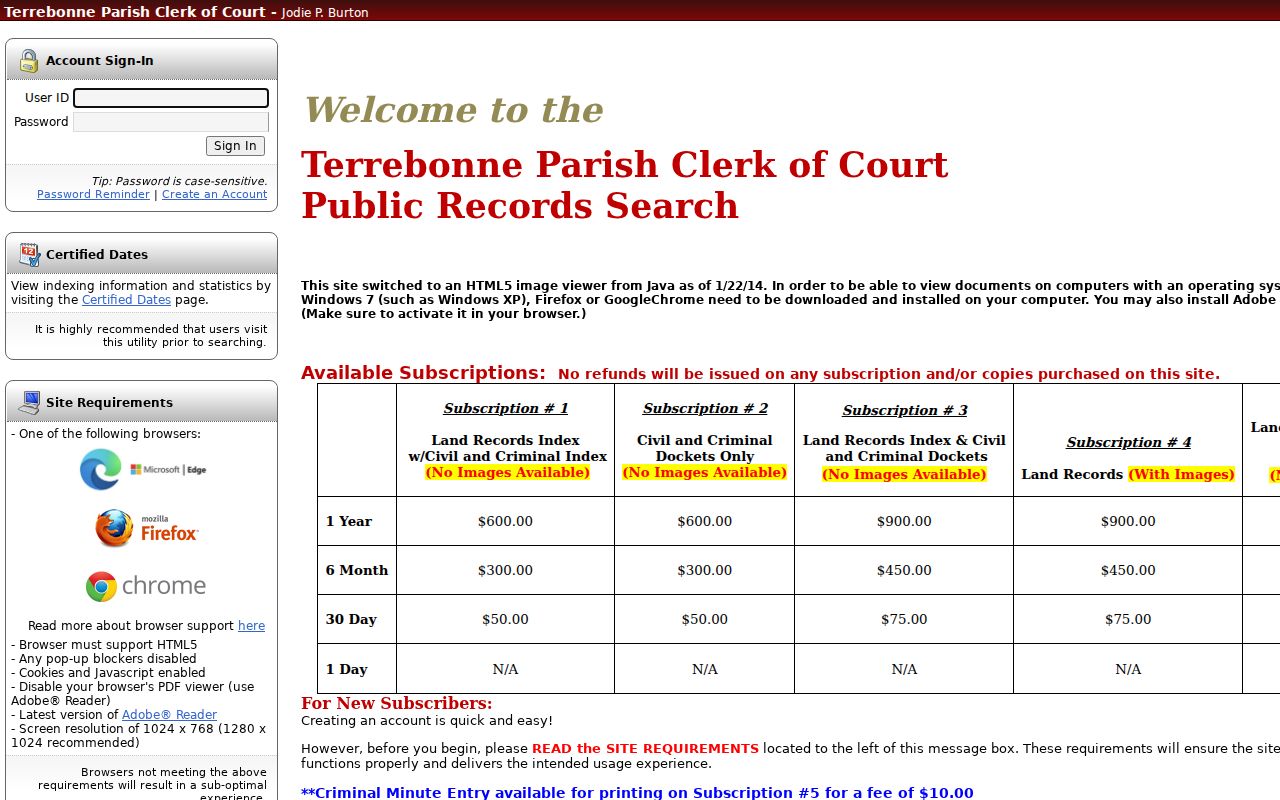
The screen confirms why a previous-owner search must include phone, counter, and copy channels instead of assuming open web images.
Old Houma Street Names Matter
A failed address search may reflect a changed label, not an absent record. Terrebonne ordinances renamed duplicate streets in 2001 and sent the changes to postal, emergency, and public agencies. A 2025 ordinance renamed Billy Street as Hazel Boykin Street. Bridge and annexation records in 2026 show that the address landscape still changes.
Search both names and keep the effective date. Compare the Assessor's legal description, GIS street centerline, subdivision plat, old directory entry, and deed reference. The parcel geometry can link the modern map to an older printed name even when a search engine cannot. The dedicated Houma street directory carries the full modern address workflow.
Insider tip. Treat the legal description as the stable key whenever a road name, house number, postal city, or municipal boundary has shifted.
Houma Past Residents Beyond Owners
Deeds identify title parties, not every person who occupied a home. The library's Houma directory run can add named residents and firms, while census pages may show a full household on one enumeration date. The library lists Terrebonne census extracts from 1840 through 1910 except 1890. The most recent public federal census is 1950 under the 72-year release rule.
- Choose a dated directory entry tied to the address or its older label.
- Find the nearest public census and verify the ward or enumeration district, the area assigned to one census taker.
- Compare names, ages, relations, and occupations without assuming that a directory year and census year describe the same household.
- Move to the next directory year and note who appears, disappears, or changes roles.
The 1897 Directory of the Parish of Terrebonne includes officers, firms, trades, plantations, streets, and residence clues. Rogers Parish Directory Co. published it in New Orleans. Its OCR can misread clear type, so confirm a hit on the scanned page. The full collection details belong with the Houma city directories.
Map Houma Address History
Sanborn fire-insurance maps add building facts that names alone cannot supply. Terrebonne Parish Library lists digital Sanborn coverage from 1867 to 1970, and the Library of Congress has a digitized Houma item from 1898. Sheets can show street names, number patterns, building footprints, construction, and use at the map date.
A map does not name all previous residents. Use it to test whether a structure existed, whether lots were divided, and whether the address sat on the same block. Then return to directories, deeds, census pages, newspapers, or church records for people. This pairing prevents a later building from being assigned the history of an earlier structure on the same land.
Houma Permit Search Fallbacks
TPCG directs permit users to its permit office and MGO Connect, but the research did not confirm a complete public result search for old Houma permits. Begin with the project address, both old and new street names, parcel number, rough date, and permit type. Ask the Permits office whether an index, image, or paper file is available.
If no public portal exposes the file, use the TPCG public-records request route under Louisiana Public Records Law. Request a narrow date span and releasable records for the address. A permit may name an applicant, owner, contractor, or project contact. Each is a role in that file, not automatic proof of residence.
End Houma Resident Trails
Obituaries, probate files, cemetery sources, and church registers can explain why a name leaves the address trail. The library's Terrebonne and Lafourche obituary index covers 1885 through 2007 and acts as a finding aid. Clerk successions begin in the online certified table at 1988, while wills reach 1854. Older or unindexed material may require the Clerk, library, State Archives, church, newspaper microfilm, or cemetery office.
The Louisiana Cemetery Board maintains a licensed-cemetery inventory, but individual cemeteries keep burial records. Open the Terrebonne cemetery listing to identify the right custodian.
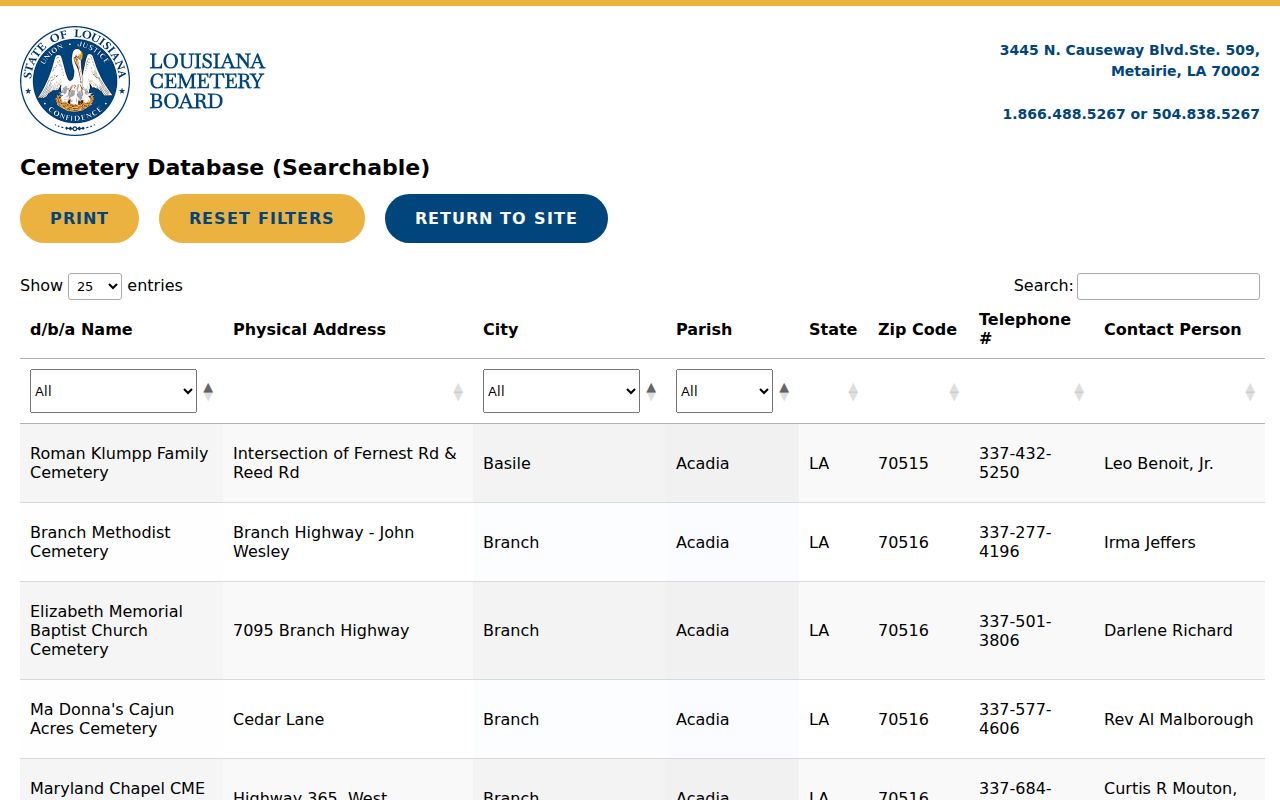
The listing helps route the request. A burial, succession, or obituary can close one part of the timeline, but none alone establishes the person's final home address.
Limits on Houma Previous Residents
An assessor owner, deed party, voter address, postal city, and physical parcel describe different facts. None is a complete household list. Current occupants may not own the parcel, and names found in old papers may refer to a business, estate, mailing recipient, or person with the same name. Keep a source date and role beside every entry.
Protected addresses, sealed records, confidential vital files, and unnamed household members remain outside a lawful house-history search. Do not try to reconstruct a physical address for a participant in Louisiana's Address Confidentiality Program.
Document uncertain gaps instead of filling them with a guess. A missing directory year may require a library inquiry, and a deed older than the online conveyance range may require the Clerk's counter or early books. The State Library, Louisiana State Archives, Nicholls State University Archives, diocesan research room, newspaper microfilm, church records, and cemetery custodian provide separate fallback channels. Ask for a tight name, address, date, and record type so staff can identify the right volume or index.
Lawful use. Research past residents for family history, estate work, or curiosity, never to watch, harass, intimidate, or harm a living person.