
Finding Residents Across Houma Records
There is no official roll of every person in Houma. The useful records were made for separate public tasks. The Terrebonne Parish Assessor links an assessed owner to a parcel. The Registrar of Voters checks registration through personal fields. The Clerk of Court indexes people named in deeds, successions, marriages, and court matters. A city directory fixes a name to the wording and date of a printed entry. Each result states a role, not a whole life.
Choose the first source by what is known. An exact street address belongs in the property search. A full name and basic personal details fit the voter portal. An old address or relative belongs in the library collection. Save dates and identifiers before moving on. That simple habit prevents a current owner, mailing recipient, voter, court party, and past householder from being treated as the same thing.
- Search the Terrebonne Parish Assessor by property address, parcel number, or owner name.
- Check a registration through the Louisiana Voter Portal only with the required identifying fields.
- Use the Clerk index or the courthouse counter for deeds, cases, marriages, wills, and successions.
- Ask the Terrebonne Parish Library genealogy room for the relevant directory, obituary index, census extract, or yearbook.
- When no public search exists, send a narrow request through TPCG Public Records.
Houma Records Desks and Custodians
Houma is the parish seat, so the most important resident rolls sit with Terrebonne Parish offices. The Clerk records legal instruments and maintains court paths. The Assessor publishes parcel assessment data. The Registrar handles voter records under Louisiana election law. Their counters also matter. The Clerk's main online system is subscription-gated, and older books or records outside certified online ranges may require an office search, a copy order, mail, phone, or an in-person visit.
A source's keeper is the best place to correct or certify it. For full work by address, the Houma street directory workflow separates parcel ownership from signs of residence.
Houma Parcels as a First Match
The Assessor is often the fastest free starting point because its search accepts several forms of the same place. A result can show the physical, or situs, address, the owner's mailing address, parcel number, legal description, assessed values, homestead status, and deed references shown with the assessment. Assessment data is not conclusive title. Confirm a transfer in the recorded act when title matters.
| Search mode | Best use |
|---|---|
| Parcel number | Reopen one exact assessment record |
| Name | Find parcels assessed to a named owner |
| Property address | Tie a physical place to its parcel |
| Section, township, range | Work from land description |
| Subdivision or legal description | Resolve a lot when street wording changed |
The Assessor search screen shows the official starting fields used in the Houma residents directory process.
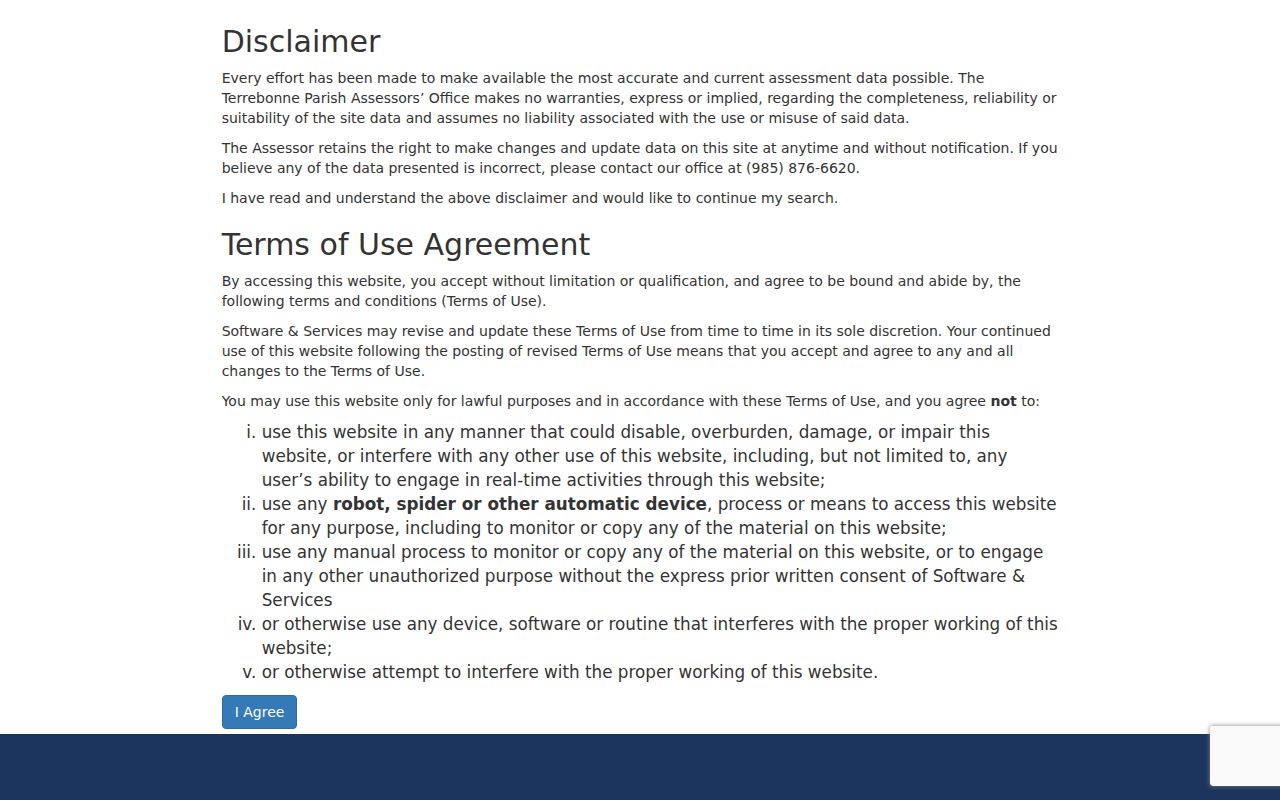
The screen gives several ways to reach the same parcel, which is useful when a name is misspelled or an address was entered in another form.
Houma Voter Details Stay Narrow
The state voter lookup is not a browseable resident roster. A name search asks for first name, last name, ZIP Code, and birth month and year. Its address mode asks for ZIP, street address, optional apartment or lot, and city. Louisiana R.S. 18:154 restricts sensitive fields and the commercial circulation of voter data. Registration can support an identity match, but it does not prove who occupies a home today.
The official voter login is the direct check for a person who supplies the required facts.
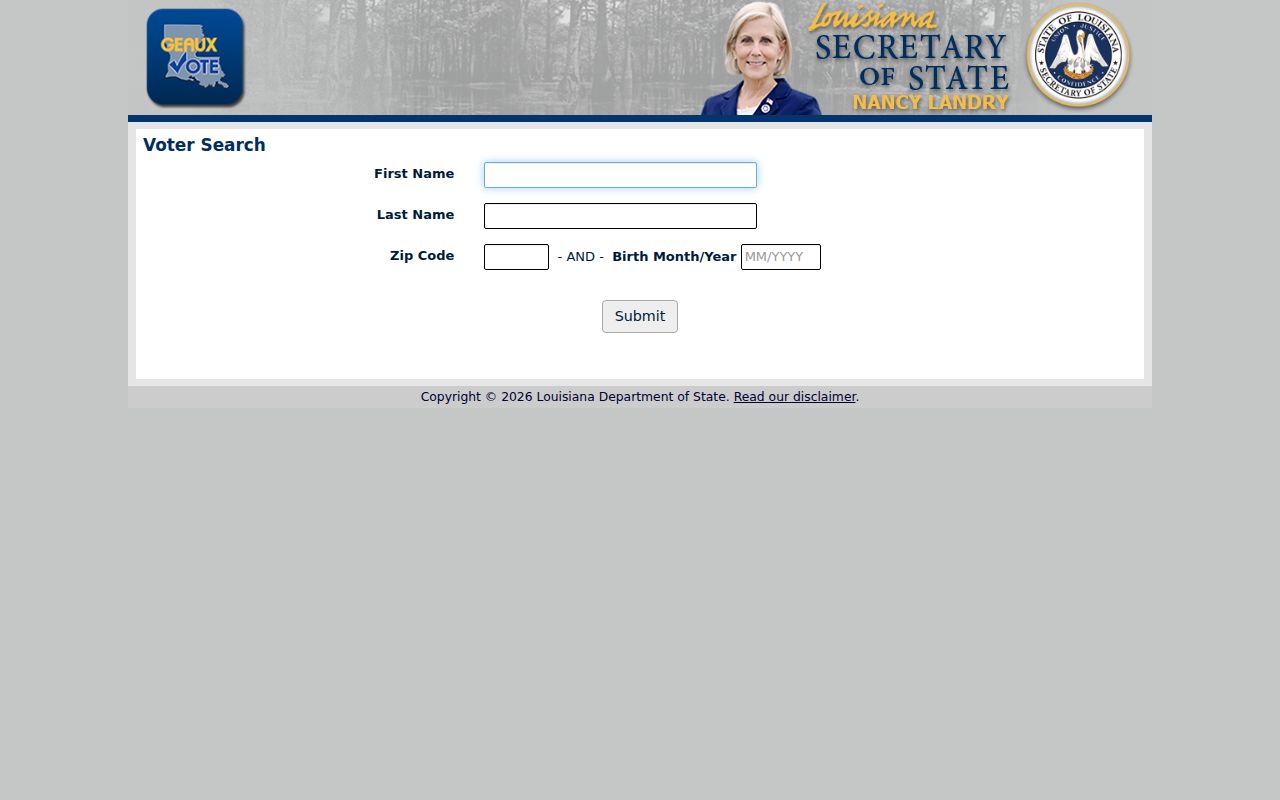
The required date and ZIP fields make this a confirmation tool, not a way to scan all Houma residents by surname.
Clerk Indexes Behind the Login
The Terrebonne Parish Clerk's Cott system places land and court indexes behind an account. Its public certified-date table shows why checking scope first matters: conveyance indexes begin in 1971 online, civil in 1990, criminal in 1994, marriages in 1935, successions in 1988, and wills in 1854. The broader Conveyance/Copy Department describes records from 1822 to the present. An online cutoff is therefore not the beginning of the record series.
Subscription choices divide land indexes, images, and civil or criminal dockets. The visible fee schedule included several thirty-day tiers from $50 to $100, a one-day image option where offered, $1 printing, and a $10 criminal minute entry on one tier. Fees can change. Before paying, call 985-868-5660 or ask whether a counter name search, mail request, or copy order fits the task.
- Index
- A finding list that points to an underlying record.
- Parcel
- A mapped unit of land with its own assessment identifier.
- Situs address
- The physical location of property, which may differ from an owner's mail address.
- Certified copy
- An office-issued copy authenticated by the record custodian.
Current Directory Sources for Houma
A modern Houma residents directory is best treated as a set of dated official rolls. None covers everyone. Match the source to the role being checked, then inspect the record itself. A business filing can identify an officer or registered agent. A board roster can document a public appointment. Neither proves a home address.
| Official source | Name's role | Keeper | Access route |
|---|---|---|---|
| Property assessment | Assessed owner | Terrebonne Parish Assessor | Free web search and office |
| Voter registration | Registrant | Registrar of Voters | Identity or address lookup; list request rules |
| Recorded instruments | Grantor, grantee, or other party | Clerk of Court | Subscription index, counter, copy request |
| Court records | Named case party | 32nd JDC or Houma City Court | Clerk assistance and available web route |
| Boards and commissions | Dated civic appointee | TPCG | Public roster and meeting records |
| Business filings | Officer or registered agent | Louisiana Secretary of State | Commercial Search |
A careful Houma resident lookup uses two matching details before deciding that records concern the same person.
Houma Court and Vital Trails
The 32nd Judicial District Court and Houma City Court serve different case paths. The Clerk indexes civil suits and offers paid name searches, while the Houma City Court route provides a public-facing search path and clerk contact. A docket is a dated list of activity in a case. It may show a person as a party, lawyer, or other role, so the case number and filing date must stay with the name.
The court search screen helps establish the correct local forum.
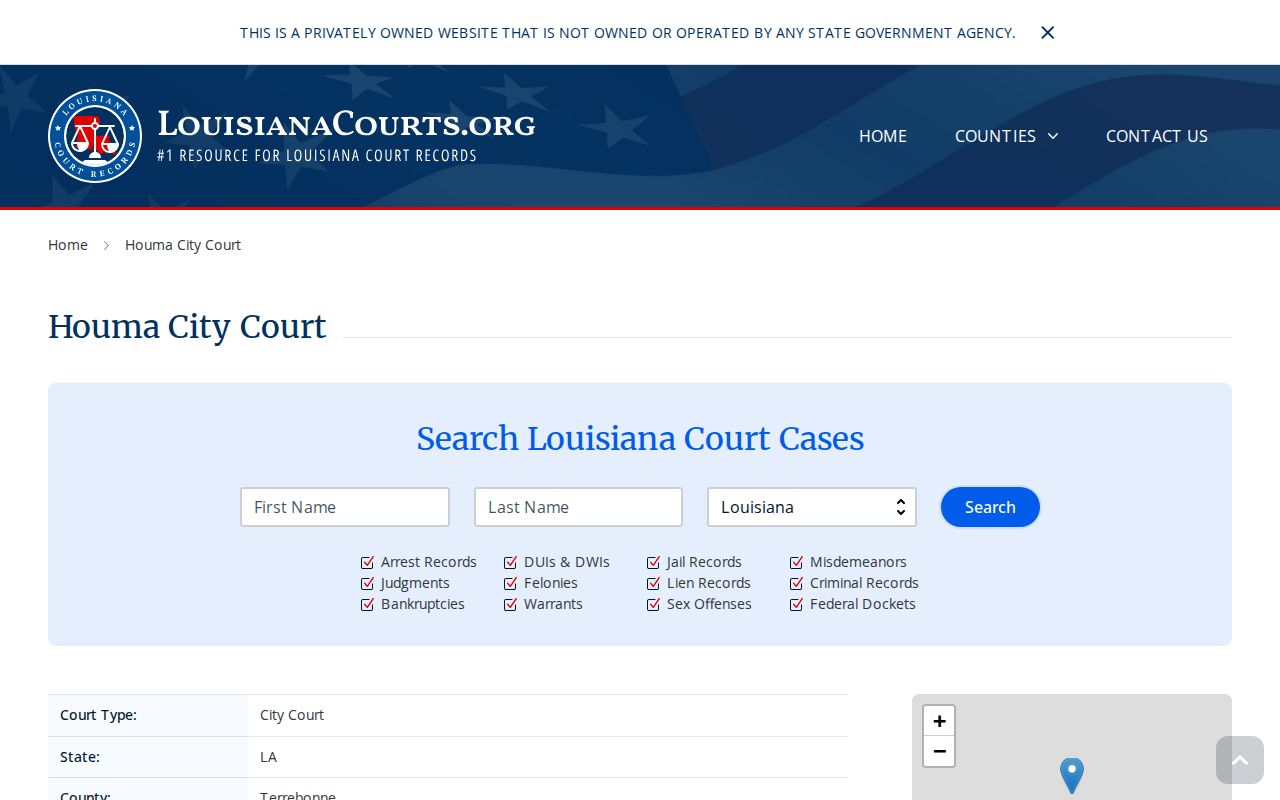
The image is a route to court material, not proof that a person still lives in Houma.
Vital records follow separate rules. The local Clerk can issue eligible birth certificates for $34, a birth certificate and card package for $48, and qualifying death certificates from July 7, 2012 forward for $26. The observed local counter was cash only, required identification, and limited copies by relationship or law. Births stay confidential for 100 years and deaths for 50 years under La. R.S. 40:41. Older eligible indexes route to the Louisiana State Archives.
The local vital-record page shows the Houma access route.
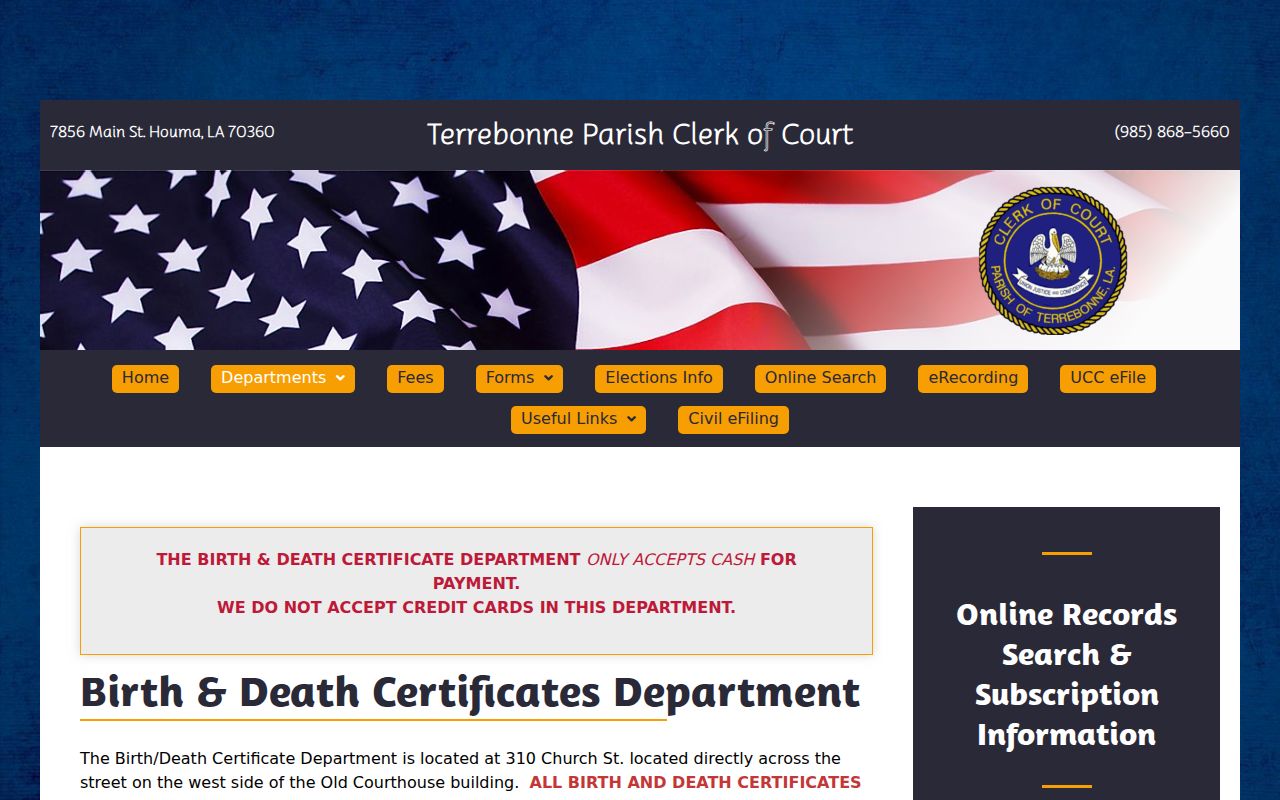
Eligibility, ID, copy type, and record age should be checked before a trip to the counter.
Louisiana's Confidential Reunion Route
Sealed adoption files are not a back door to finding a protected address. Louisiana instead maintains an official voluntary reunion process. Eligible adoptees and relatives can use the DCFS Adoption Reunion Voluntary Registry, which works by confidential mutual consent. That route respects the sealed record while giving relatives a lawful way to seek contact.
Other protected addresses deserve the same restraint. Louisiana's Address Confidentiality Program can substitute a public mailing address for eligible participants. Voter and vital-record restrictions also close sensitive fields. Never try to identify a protected person by combining partial public records.
Lawful personal use. Houma records may support genealogy, heir research, civic review, or scam checks. Never use an address or identity detail to stalk, harass, or harm anyone.
Public Requests Fill Houma Gaps
TPCG has no visible public name search for every permit, nuisance file, occupational license, or department record. The fallback is the custodian, not an unsupported claim that the data does not exist. Louisiana R.S. 44:31 permits any adult to inspect or copy public records, without a Terrebonne residency requirement. R.S. 44:32 sets custodian duties. A useful request states the department, exact record series, date span, address or parcel number, and preferred electronic format.
The local custodian is Robbie Lee at Government Tower, Suite 705, publicinfo@tpcg.org, 985-873-6403. Posted fees include free email delivery, $0.25 per paper page, and separate listed charges for certain reports or media. Production timing depends on whether the record is ready or active, so avoid promising a fixed delivery date.
The TPCG request page presents the official intake and fee details.

This request route matters most when the online directory trail ends at a blank search shell or a record held only by a department.
Older Houma Directory Shelves
The Terrebonne Parish Library genealogy collection is the central historical source. Its stated Houma directory run begins in 1897 and reaches the present, though each annual title should be confirmed with staff. Identified volumes include the Directory of the Parish of Terrebonne, 1897, published by Rogers Parish Directory Co. of New Orleans, and the 1938 to 1939 Houma volume issued by State Directory Company. The early book is parish-wide, with civic officers, trades, streets, plantations, and rural sections.
The same second-floor genealogy room at the Main Branch holds local yearbooks, newspaper microfilm, Sanborn maps, church material, Terrebonne census extracts from 1840 through 1910 except 1890, and obituary indexes for Terrebonne and Lafourche newspapers from 1885 through 2007. Ask for a title, year, name, and page image. OCR can fail on old print, as the 1897 scan's reading of “Parish” as “Darish” shows.
The library genealogy page identifies the Houma collections and access route.

The library shelf adds the dated household and street context that a current parcel search cannot supply.
Houma Addresses Changed With Time
Modern address systems can hide older residents. TPCG's 2004 budget recorded a master address database and 55,125 digitized structure addresses tied to GIS and E911. Earlier street-renaming work in 2001 addressed duplicate names and sent changes to USPS and emergency agencies. Billy Street became Hazel Boykin Street in April 2025, and 2026 council records show another named-place update at the Thompson Road bridge crossing Bayou Chauvin.
When an old directory search stops, keep both street names, the date of change, the legal description, and the parcel number. Louisiana R.S. 18:201 requires certified reporting around street-name or number changes to the Registrar of Voters. That record trail can bridge a historical entry to the modern address without assuming that the postal label and city limit are the same.
Note: A mailing address, voter address, postal city, and physical parcel are distinct fields, and none alone identifies a complete Houma household.
Record Every Houma Match
The last step is documentation. A useful worksheet records the source URL, access date, record type, exact spelling, person's role, physical or mailing address label, parcel or case number, tax year, filing date, and access limits. Mark an index as an index. Save the original page when possible. If two sources disagree, retain both dates instead of forcing one answer.
Official rolls and commercial people-finder results are not equal. An official index identifies its custodian, purpose, and date, and it offers a path to the underlying record. A commercial result may merge old addresses or people with similar names and may not disclose how a match was formed. Use the official Houma residents directory sources first, then verify any outside claim with the office that holds the record.
A same-name match needs at least two sound anchors. For a parcel, pair the name with a parcel number, legal description, deed date, or book and page. For a court result, keep the case number, court, role, and filing date. For a historical entry, retain the directory year, printed page, street wording, occupation, spouse, or nearby business. Initials and spelling shifts are common in old Houma material, and OCR can introduce new errors. Search variants, but do not merge people until the original records agree.
Geography needs its own check. Terrebonne Parish records can name Houma, Bayou Cane, Chauvin, Dulac, Gray, Montegut, Schriever, Bourg, Cocodrie, or Gibson. A postal Houma label does not settle the city boundary. Preserve the locality exactly as the source prints it, then consult the parcel and GIS layers for modern context. This is especially useful along bayou roads and near annexation lines, where postal, ward, city, and service labels may differ.
Finally, distinguish a free finding aid from a certified record. The Assessor, GIS, voter confirmation, library catalog, and some state searches can be opened without a fee. Clerk images, staff name searches, certified copies, and certain reports may cost money. Record what was searched even when it returned no match. A dated negative result within a stated coverage range is more useful than an undocumented claim that no record exists.
| Keep with the result | Why it matters |
|---|---|
| Name and role | Separates owner, voter, officer, and case party |
| Source and date | Shows when the claim was true or observed |
| Parcel, book/page, or case number | Points back to the underlying record |
| Address type | Prevents mailing and physical addresses from being merged |
| Confidence note | Records what supports a same-person match |